Chhatrapati Shivaji Maharaj: The King vs. The Modern Icon
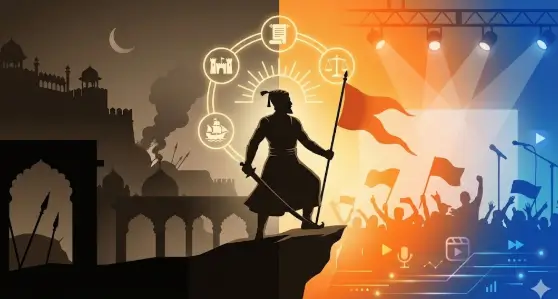
Chhatrapati Shivaji Maharaj remains one of India’s most influential historical figures. However, his image today is shaped not only by historical records but also by social reform movements, nationalism, and modern political narratives.
Over generations, Shivaji evolved from a regional Maratha king into a national icon. Understanding this transformation helps separate historical fact from symbolic interpretation.
The Origin of Shivaji Jayanti
The public celebration of Shivaji’s legacy did not begin through a royal proclamation or government order. It began with rediscovery.
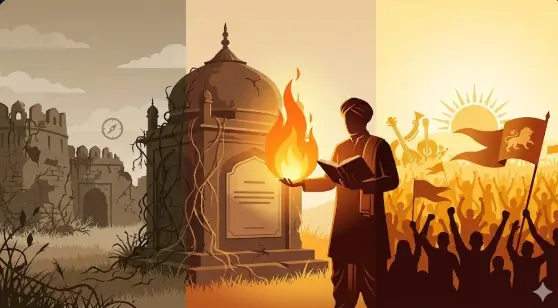
In 1869, social reformer Jyotirao Phule located Shivaji’s neglected tomb at Raigad Fort.
The First Public Celebration (1870)
In 1870, Phule organized the first Shivaji Jayanti celebration in Pune.
Why did he do this?
Phule saw in Shivaji not just a warrior king, but a symbol of dignity for oppressed communities. He referred to him as “Kulwadi Bhushan” (Jewel of the Peasants) and used his legacy to inspire self-respect among lower castes and farmers. For Phule, Shivaji represented resistance against feudal and caste-based oppression.
Mass Popularization in the 1890s
Later, nationalist leader Bal Gangadhar Tilak expanded Shivaji Jayanti into a mass public festival.
At a time when British authorities restricted political gatherings, Tilak used cultural celebrations to foster nationalist unity. This transformed Shivaji into a broader symbol of resistance and self-rule.
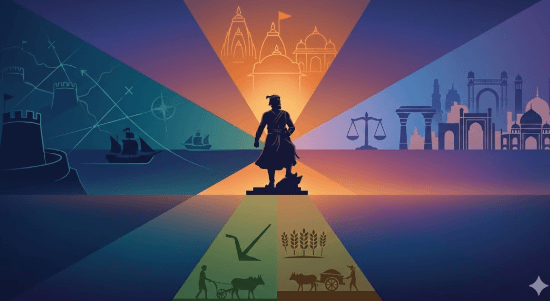
One King, Many Interpretations
1️⃣ The Hindu Nationalist Icon
Many groups highlight Shivaji as the founder of Hindavi Swarajya — self-rule rooted in indigenous traditions.
This interpretation emphasizes:
- Resistance against Mughal expansion
- Protection of temples
- Defense of Hindu dharma
2️⃣ The Inclusive Secular Administrator
Historical records show that Shivaji’s administration included Muslim officers such as:
- Daulat Khan (Naval Chief)
- Ibrahim Khan (Artillery Head)
He reportedly ordered his soldiers to respect mosques and the Quran during military campaigns.
This presents him as a pragmatic ruler rather than a sectarian one.
3️⃣ The People’s King (Ryotacha Raja)
Writer Govind Pansare emphasized Shivaji’s administrative reforms:
- Regulation of land revenue
- Protection of women’s dignity
- Merit-based appointments
- Focus on agrarian welfare
In this interpretation, Shivaji is remembered as a ruler who prioritized justice and farmer welfare.
4️⃣ The Military Visionary

Shivaji pioneered naval defense strategies and built strategic coastal forts to counter European colonial powers.
Because of this, he is often regarded as a foundational figure in India’s naval history.
His use of:
- Guerrilla warfare
- Fort architecture
- Rapid mobility strategies
demonstrates advanced military planning.
The Gap Between History and Symbolism
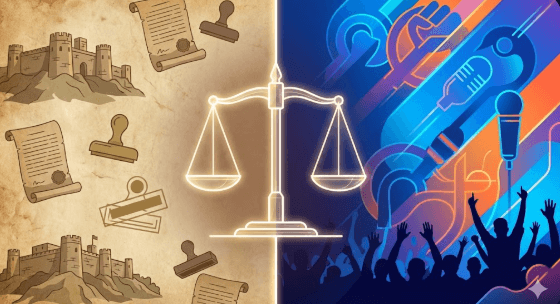
There is often a difference between:
- The historical Shivaji — a pragmatic strategist focused on state-building.
- The symbolic Shivaji — a modern political and cultural icon.
Historically, Shivaji fought:
- The Mughals
- Regional Maratha rivals
- Deccan sultanates
His wars were political, not purely religious. His primary goal was Swarajya — self-rule and sovereignty for his kingdom.
Modern political groups sometimes emphasize selective aspects of his life to support contemporary narratives. However, historical evidence suggests a leader whose governance was rooted in justice, administrative efficiency, and social balance.
Conclusion: Beyond the Labels
Chhatrapati Shivaji Maharaj cannot be confined to a single narrative.
He was:
- A visionary state-builder
- A military innovator
- A social reform inspiration
- A nationalist symbol
Understanding him requires separating mythology, political usage, and historical documentation. When we examine him carefully, we find not a one-dimensional icon, but a complex and strategic ruler who shaped the course of Indian history.