
What Nirmala Sitharaman Said About Students & Education in Union Budget 2026-27

Introduction: A Budget Framed Around “Yuva Shakti”
Presenting the Union Budget 2026-27, Finance Minister Nirmala Sitharaman described it as a “Yuva Shakti–driven Budget”—placing India’s youth at the center of growth, innovation, and employment.
Education emerges as one of the strongest pillars of this vision, with a record allocation of ₹1,39,289.48 crore for the Ministry of Education, an increase of 8.27% over last year.
Rather than only expanding traditional institutions, the budget focuses on:
- Technology-enabled learning
- Skill-based education
- Research and innovation
- Creative and emerging industries
This article breaks down exactly what the Budget says about students and education and how it may affect your future.
Education Budget 2026-27: The Big Picture
The total education allocation is divided into:
- School Education & Literacy: ₹83,562.26 crore
- Higher Education: ₹55,727.22 crore
What this signals
- Stronger digital infrastructure in schools
- Better-equipped classrooms and labs
- Continued expansion of higher education capacity
The government is clearly prioritizing quality, technology, and access, not just numbers.
Study Abroad Gets Cheaper
Students planning to study overseas receive one of the most direct benefits.
What changed
- Tax Collected at Source (TCS) on remittances under the Liberalised Remittance Scheme (LRS) for education and medical purposes reduced
- From 5% → 2%
Why this matters
- Lower upfront cost when sending tuition or living expenses abroad
- Reduced financial stress for families
- Improved access to global universities
This step quietly removes a major financial friction point for international education.
From Rote Learning to Creative Thinking
(Place conceptual illustration here — student breaking free from exam pressure)
One of the strongest underlying messages of the budget is a shift away from purely exam-driven education toward creativity, problem-solving, and interdisciplinary learning.
This philosophy shows up across multiple announcements.
Creative Economy (“Orange Economy”) Enters Mainstream Education
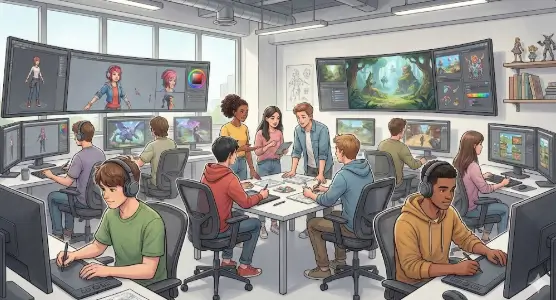
The government formally recognizes creative industries as major employment generators.
Key initiatives
- AVGC Content Creator Labs (Animation, Visual Effects, Gaming, Comics)
- In 15,000 secondary schools
- In 500 colleges
- Backed by the Indian Institute of Creative Technologies (IICT), Mumbai
- Establishment of a new National Institute of Design (NID) in eastern India
What this means for students
- Gaming, animation, and design are now treated as legitimate career pathways
- Early exposure to creative tools and industry workflows
- More structured talent pipelines into high-growth sectors
Creative careers are moving from “alternative” to mainstream.
Artificial Intelligence Becomes a Core Education Pillar
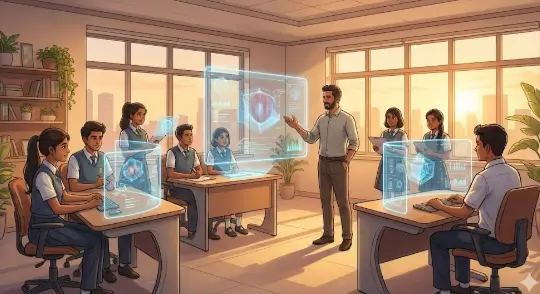
AI featured repeatedly in the budget speech, signaling long-term commitment.
Announcements
- High-powered committee to integrate AI into school curriculum
- ₹100 crore for Centres of Excellence in AI for Education
- Launch of Bharat-VISTAAR, a multilingual AI knowledge platform
Impact
- Students introduced to AI concepts at earlier stages
- Better alignment between education and job market needs
- Expansion of AI research and teaching capacity
AI is no longer optional—it is becoming foundational.
University Townships: Rethinking Where Learning Happens
The budget proposes creating five University Townships near major industrial and logistics corridors.
What will they include
- Universities
- Research centers
- Skill development hubs
- Industry collaboration spaces
Why this matters
- Shorter distance between classroom and workplace
- More internships, apprenticeships, and applied research
- Faster transition from education to employment
Education ecosystems will be built around industry clusters, not isolated campuses.
Supporting Women in STEM
To improve access and safety:
- One girls’ hostel in every district for STEM institutions
This addresses a major barrier that prevents many women from pursuing science and technology education away from home.
Medical, Pharma & Mental Health Education Expansion
Capacity growth
- 10,000 new medical seats in 2026-27
- Target of 75,000 seats over five years
New institutions
- 3 National Institutes of Pharmaceutical Education and Research (NIPERs)
- 3 All India Institutes of Ayurveda
- NIMHANS-2 in North India (mental health and neurosciences)
Research support
- ₹600 crore allocation for PM Research Fellowship (PMRF)
This strengthens India’s pipeline of doctors, researchers, and healthcare professionals.
Skill-Based Learning & Job-Oriented Programs
The budget continues shifting focus from degree-only education to employability.
Key measures
- ₹3,200 crore for Atal Tinkering Labs
- ICAI & ICSI to develop short courses for Corporate Mitras (para-professionals)
- Training of 10,000 tourist guides in collaboration with IIMs
Outcome
- Faster job readiness
- Micro-credentials and short-term certifications
- More pathways for commerce and humanities graduates
Areas of Concern for Students
Despite positive moves, some reductions raise concerns:
- Significant cuts in minority scholarship schemes
- Reduced allocation for PM Internship Scheme (₹4,788.45 crore)
Students from vulnerable backgrounds may feel these effects most.
What This Budget Ultimately Signals
Union Budget 2026-27 positions education as:
- Tech-driven
- Skill-oriented
- Research-focused
- Globally connected
Instead of promising quick giveaways, the government is attempting to reshape the education ecosystem for the next decade.
Final Takeaway
What Nirmala Sitharaman said about education in Union Budget 2026-27 can be summarized simply:
India’s future growth will be powered by students who can think, create, and adapt—not just memorize.
For students, the biggest wins are:
- Cheaper study abroad
- AI in classrooms
- Creative economy labs
- Expanded medical seats
- Industry-linked campuses
This is a long-term, structural education budget rather than a short-term populist one.
Disclaimer: This article is based on Union Budget 2026-27 announcements. Students and parents should verify details through official government notifications